Showing posts with label south georgia. Show all posts

Tuesday, 8 October 2013

The Circle of Life in South Georgia and Antarctica - Penguins, Seals and Others

Warning: this post contains explicit content some readers may find disturbing.

Looking back at the expedition now, one thing that surprises me is how the most extraordinary things were so simple and ordinary in the wilderness.

Life and death should be extraordinary events in our city lives. I mean, how many of you witness death, even for animals, on a regular basis? I certainly haven't seen a dying or dead animal (except for that time when I hit a badger, or at least I think it was a badger, at 70mph). Yet, when we saw injured, dying or dead animals in Antarctica, it was just so natural, so matter of course.

Each of the animals in this post had their own stories. They may not be the same stories as what I am telling here. Nevertheless, they each deserve a few words, and a moment of our appreciation. Appreciation for the gift of life, and all the opportunities and responsibilities that come with it.


Nature can sometimes be very real and in your face. We came across this gentoo on our first day in South Georgia. It was quite clear that he would not heal from the wound without any help. And there was no help we could give, other than possibly killing it to put it out of its misery. It was only a matter of hours, perhaps a day, before he became too weak to defend against infection, or the giant petrel that was perched waiting only metres away.


Our expedition in Feb/Mar 2013 coincided with South Georgia's cull of all reindeer on the island. Originally an invasive species introduced by the Norwegians over 100 years ago, their recent explosion in numbers caused by a decline in the human population and hunting on the island. This has in turned caused a number of problems to the local flora and fauna. Ironically the high profile cull was carried out by professionals hired from Norway.


We came across reindeer carcasses almost every day. This one had most of its meat stripped out, organs removed, leaving behind the skeleton, a pool of blood, and a bullet hole.


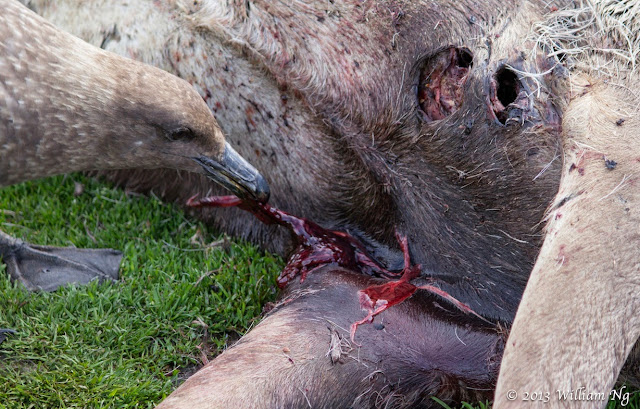
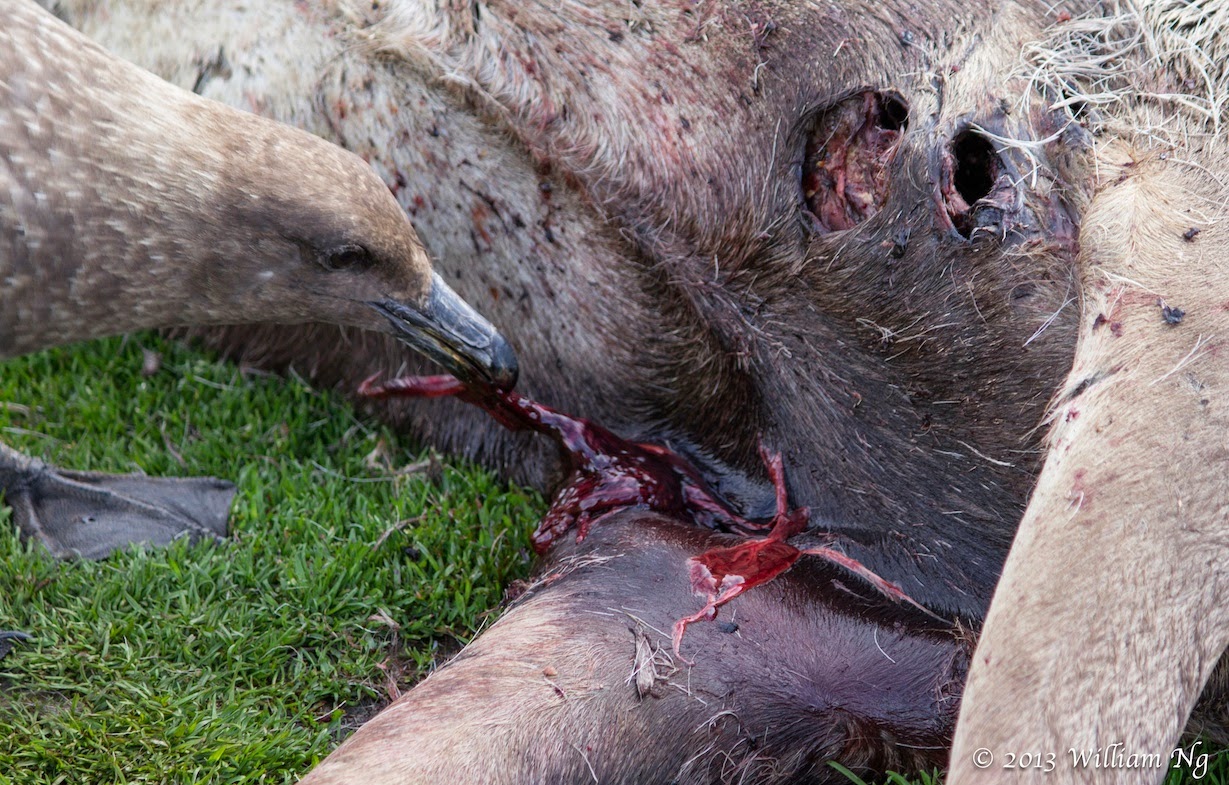
Sometimes the reindeer is just left, to the delight of scavenger skuas.
 
Derelict whaling stations scatter across South Georgia. Most of them are closed to the public due to risk of asbestos. The only one that was open to us was in Gryvitken. These vats were used to boil the whale blubber to extract whale oil, once the giant whales were carved up...


A photo found in the Gryvitken museum depicting the process of skinning and carving a whale using a range of tools once it was taken back to the station.
There were lots of fascinating history in the museum. In order to make the process of hunting whales more efficient, whaling ships harpooned a floater and a tracking device into the whale so they could keep it afloat and track it later while they move on to make another kill, and so on, until the end of the day when they return to tow them all back to base.


A set of whale bones found at Port Lockroy in the Antarctica Peninsula.


Two gentoo chicks seeking warmth from their mother. It was with almost certainty that the smaller one will not survive. Winter is looming and it just isn't big enough to survive the cold, nor is it able to compete with the older sibling for meals from the parents.


Dead penguin = good meal for scavenger skuas


Just to end on a slightly happier note, this is how they make little penguins.


Monday, 23 September 2013

Elephant seal sex - South Georgia and Antarctica


Two juvenile elephant seals play fighting, getting practise for real fights for their hareems in future
Warning: this post contains explicit content some readers may find disturbing. 

But I'm sure you'll read on anyway.

So by the time we got to our final day in South Georgia, we were all pretty much maxed out on smelly penguins covered in shit, and slightly fed up with having growling fur seals chasing after us. We were definitely looking forward to heading down to the Peninsula to see more ice and other wildlife on offer there. Nevertheless, we still wanted to get the most out of our final landing on this beautiful island that had so far filled us with so many surprises and lasting memories.


South Georgia Day 5: Golden Harbour

What we went on to witness was certainly memorable, whether it was a beautiful sight is open to debate.

Golden Harbour was home to the second largest mixed penguin colony that we saw in South Georgia. Amongst the penguins were lots of juvenile fur seals that were too hormonal and wanted a fight every time something or someone went near them. Our walking sticks were definitely needed here. The main characters of this episode however, were the elephant seals.


Specifically two elephant seals, which we came across almost as soon as we landed. 

The larger one was a male juvenile, weighing in roughly 2-2.5 tonnes. The female was much smaller. Experience told us that females are generally smaller than the males, but this one was quite a lot smaller, at least half his size, presumably because she was also a lot younger.

Then, without any warning, before we (and she) realised what was happening, he climbed on top of her. Almost immediately she tried to escape and wriggle herself free. But he was too strong and too big. He pinned her down with his right flipper. She struggled a little, but there was nothing she could do.

For the several minutes that ensued, we watched, awestruck. There was nothing we could do either, except for taking photos and filming the whole event.

Once it was over, he fell to the ground with a thump, and she finally got away. Still in shock and fear, or fearing it would happen again, she quickly moved away from the pack and spent the rest of the afternoon isolated.

That was one of the cruellest moments of our expedition.


Saturday, 1 June 2013

Antarctica Itinerary - Location Tracker

I've written a few posts about the ice, penguins and some practical information about the trip, but you might ask, how do they all fit in? Here's my South Georgia / Antarctica itinerary:


February
8th - day trip to Volunteer Point, north eastern tip of the Falklands.

9th - 13th - Boarded the Golden Fleece. Sailing day and night from the Falklands to South Georgia. Spent Chinese New Year (10th) at sea - first time in my life I didn't celebrate it in the slightest as I was too busy trying not to be sea sick. 

14th - first landing of the trip at Elsehul, where some of the group saw a live penguin being taken and literally ripped apart from a group of petrels. It was also the only one time we saw an albatross colony. Our second landing in the afternoon was at Prion Island, where we were ironically chased by baby fur seals along the only man-made walkway we encountered on the whole trip. I also saw a penguin with a gaping wound on its side; I was pretty sure it wouldn't survive to the next day.

15th - landed at Salisbury Plain in the morning. It was breathtaking, metaphorically and literally - I could smell the pink poo when we were still at sea. The biggest King colony in South Georgia, there were an estimated over 200,000 of them. Later on we passed Prince Olav Harbour, which is a derelict whaling station, and landed at Posession Bay, where we saw a male fur seal trying his luck with a female. She wouldn't have any of it.


16th - we woke up to what was arguably the most spectacular sight on the whole trip: a towering iceberg over 100m tall in the morning mist. Apparently given its size it was likely to have been broken off from the Ross icesheet over 10 years ago. After that we started at Fortuna Bay and trekked part of Shackleton's trail to Stromness Bay, which is also a derelict whaling station. Sliding down ice slopes was pretty good fun!


17th - we spent the whole day at Gryvitken, resting and refilling the fresh water tank. Gryvitken is about 1km from South Georgia's capital, King Edward Point. We visited the museum, sent a few postcards from the post office, and did some trekking - where we saw Ernest Shackleton's grave, jumped over some pretty feisty elephant seals, and saw the remains of a crash helicopter from the Falklands War. Eric also taught me some night photography techniques here.


18th - this was our last day in South Georgia. We first landed at Ocean Harbour where we saw the Beyard derelict ship, followed by seeing another large King penguin colony and a lot of aggressive fur seals at Golden Harbour. It got cold too, and we were hit with snow showers in the afternoon.


19th - 23rd - five days of sailing through the Scotia Sea was gruelling; I spent the first two days lying down to avoid sea sickness, despite 3 different types of anti sea sickness remedies. Minimal eating (no appetite) and minimal drinking (to avoid getting up for the toilet) were not pleasant. Otherwise, the days were spent on scrabble, card games, films and processing photos.

24th - to take a break from sailing, we landed at Elephant Island, where we saw glaciers collapsing into the sea. It was also our first encounter of chinstrap penguins, who were very loud, and a leopard seal, which went on to successfully hunt a penguin (which I didn't see). This was also where I successfully caught fish using reindeer meat as bait.

25th - another day of sailing

26th - officially set foot on Antarctica. Seeing leopard seals, humpback and minke whales up close to the boat at Cierva Cove was pretty cool, and very different from the penguins and fur seals I had been used to. Second landing was Enterprise Island, where we trekked up a hill but ran into a brief snow shower which looked like a white-out. This turned out to a fun afternoon with snow ball fighting and ending in a beautiful sunset and moonrise.


27th - I missed what would eventually become the only opportunity of taking sunrise shots in Antarctica. Eric's "sleep when you're dead" motto still resonates. We sailed to Spigot Peak, which we climbed just so we could slide down the ice slope. Having a BBQ afterwards was pretty awesome, especially with a glacier in the background. In between the sailing we also crash landed on a iceberg with some dopey crabeater seals. Afternoon was spent at Curverville Island, where we saw a lot of Gentoo penguins, some with very recently hatched chicks.

28th - it was a cold miserable day. I got wet from the Paradise Harbour landing, and lost my beanie hat on the way up to the top of the hill. I really liked that hat. At Port Lockroy we sent the last batch of postcards from Antarctica before the post box closed for 6 months. The small museum and gift shop were also a nice change from penguins, seals and whales.

March
1st - landing was not a priority today, as we spotted a small pod of killer whales, or orcas, in the morning and spent an hour or two chasing them. We then saw an iceberg breaking apart and flipping in the afternoon, arguably the most spectacular sight on the whole trip. We did land on Ronge Island just to complete the day. 

2nd - last day in the Peninsula, we visited Hunt Island where we hiked to the top of a ridge with incredible views. More humpbacks got up close and started showing off, whilst two groups of Gentoos jumped for their lives as our boat approached their iceberg. Two more landings in the afternoon: one on an iceberg where we took jumping shots; the final one was full of blue eyed cormorants. 


3rd - away from Antarctica we landed on Deception Island, which had a very large colony of chinstrip penguins (allegedly 120,000 pairs). The famous Sewing Needles stuck out of the water tall and high. Then landing at Whalers Bay was like landing on Mars. The volcanic island also offered geothermally heated sand and water - perfect to bathe it!

4th - to allow the storm to by-pass us, we spent another day at one of the South Shetland Islands - Half Moon Island and Edinburgh Hill.
5th - 8th - we crossed the infamous Drake Passage, but by now I was used to sailing in the rough sea, so the 8m swells didn't bother me too much. I even managed to get a few shots of passing albatrosses and petrels.


9th - 12th - we were here right in the centre of a historic moment, witnessing the overwhelming 'Yes' majority in the Falklands referendum. The islanders celebrated, although without much style or alcohol. I even stood next to a group of chavs.


Sunday, 21 April 2013

Packing list for Antarctica, The Falklands and South Georgia

I started shopping for all the things I needed to pack only about a month prior to departure, much later than my fellow travellers, which in hindsight was a little bit of a rush, but hey, I got most of the items in the Christmas/January sale. If you can get organised quickly it's actually too bad.
 
I've categorised the list below, however, do bear in mind that:
  • I sailed on a privately chartered boat from the Falklands, lived, ate, slept (and poo'ed) on the boat for the entirety of the journey, only landing in South Georgia and the Peninsula to see the wildlife during the day;
  • went as far as Port Lockroy in the Antarctic Peninsula (at around 65°S, just north of the Antarctic Circle), at the end of the Southern polar summer, so temperatures without wind chill never dropped below -2°C during daytime.

Where sensible, I've also included cost as of Jan/Feb 2013.

This list worked for me but is definitely not exhaustive - feel free to leave a comment if you think there are other essential items too.


Prior to departure
  • Travel insurance a must - to cover all 3 locations. If anything went wrong the cost of repatriation would be phenomenal. Falklands immigration requires sufficient cover before you are allowed to enter
  • Brize Norton / Falklands return flights - £2,244
  • Cash - there are no ATMs in the Falklands, South Georgia (Grytviken), and definitely not in Antarctica (Port Lockroy or any of the bases). The main currency used in these places is British Pound Sterling (£). Falklands has a Standard Chartered bank but will charge you 4.5% fee for cash withdrawal. I had cash for Falklands airport transfer (£20 each way), South Georgia landing (£165), internet cards in the Falklands (£5 for 50 minutes), Volunteer Point day trip (£100-120), petty cash (£400) for souvenirs, postcards, meals and postcards. In total I took around £700 cash
  • Visa / Mastercard
  • Falklands accommodation - B&B's and hotels are around £70-120 per night
  • An understanding of the human impact on Antarctica, and making sure any negative impacts are minimised - priceless


Note that the Falklands have their own Pound Sterling, which is at a 1:1 rate with the GBP. Falklands money is not accepted in the UK, so make sure you use it or exchange it before you leave.
 
Clothing - warning: these will be covered in penguin/seal shit
  • Knee length fully waterproof wellies, comfortable enough for mini-hikes
  • Waterproof and windproof trousers, or ski pants
  • Thermal base layers (body) - I didn't actually need thermal long-johns, as the ski trousers proved to be sufficiently waterproof and windproof to keep my legs warm
  • Silk liner gloves
  • Warm outer gloves
  • Thermal or ski socks
  • Mid-layer - e.g. fleeces, hoodies
  • Waterproof and windproof jackets, with a hood if possible
  • Warm hat(s) - I had a close fit beanie hat and a trapper hat to cover the ears
  • Comfortable footwear whilst on board
  • Swimwear - YES swimming in the Antarctic water is a once in a life time event not many people can claim! Well, I certainly can't say I've done it myself, but I did bathe in a hole of geothermal spring at Deception Island
  • Balaclava - some people had it but I thought it was unnecessary

Medication 
  • Sunscreen - I only had SPF 20 but as a Yellow Asian it was OK; otherwise SPF 50 recommended
  • Scopoderm patches hyoscine 1mg - each lasts for 72 hours. Essential for the rough seas, but has unpleasant side effects including blurred vision, dry bitter mouth and drowsiness - £3 per patch
  • Stugeron travel sickness tablets - make sure this is taken prior to sailing
  • Travel sickness wrist band
  • Immodium
  • Antihistamines
  • Standard first aid kit (painkillers, plasters, bandages, etc)

Electronic and camera
  • Laptop with photo processing software - just to make those endless hours crossing the open sea more productive
  • Portable hard drive to back up photos
  • Filters and hoods - to reduce all the glare from the Sun, the sea and the ice/snow (there's lots of it)
  • Tripod, shutter release and head torch, especially for night time photography under almost perfect conditions (no light pollution or air pollution)
  • Spare battery and memory cards
  • Rain cover for the camera
  • Dry bag(s) - to protect the camera and lenses from condensation forming from going from the extreme cold to warmth
  • Silica gel - as above
  • GPS tracking - my friend Simon had one mounted to his camera, records location info for each photo taken
  • Underwater camera - Simon had this and proved to be very useful
  • Camcorder - Simon had this and was great for filming (much steadier than the penguins and icebergs flipping that I took)
  • Satellite phone with pre-paid card if you really want to be contactable in the wilderness. I found the boat's email system sufficient, but my fellow traveller Achut brought a GPS tracking device which uploaded our location to a website via satellite, and allowed in/out messages, which was really nice. 

Accessories

  • Binoculars - absolutely must for the spotting cool icebergs, glaciers and the wildlife (whales, albatrosses, penguins, birds...)
  • Sunglasses
  • Backpack and rain cover
  • Knee support for hikes
  • Diary or notebook - there are plenty of incredible sights and memories to remember

Personal Hygiene
  • Deodorant - I wished I took some, as I ended up not showering for 6 days, twice
  • Wet wipes
  • Lip balm with sun protection
  • Moisturisers

Entertainment / nice to have's
  • Music, books and films (preloaded on my tablet)
  • Travel scrabble (or any other board game)
  • Cards
  • Shackleton's whiskey - my fellow traveller Achut ordered this and it was fantastic! Any form of alcohol was good, though the boat provided plenty of beer and wine


What I bought in the Falklands
  • Falklands has a very well stocked supermarket called the West Store, although dry foods are sometimes out of date. Stock mostly comes from the Waitrose supermarket in the UK. This is where I stocked up on comfort foods like digestive biscuits, Cadbury's chocolate fingers and sweets
  • 1TB portable hard drive from the electrical store
  • Fresh food and veg, though less abundant and more expensive

What I did NOT need to take
  • Washing powder - provided on board, not that we had much chance to wash clothes anyway
  • Toilet paper
  • Bedding (sleeping bag, pillow etc) - all provided
  • Walking sticks - needed to ward off over-excited seals, provided on board
  • Any food or drink, other than non-perishable comfort food such as biscuits and chocolate

Sunday, 24 March 2013

On Board the Golden Fleece


So this is for real. I was actually going to set off, and wouldn't see any land for at least 4 days. This was pretty hard core for someone whose only sailing experiences were the Thames Clipper and Hong Kong's Star Ferry, neither of which lasts for more than 15 minutes. Rumour has it that the Southern Ocean has the strongest currents and the biggest swells in the world. Without any land breaking things up a little, I'd say that's more fact than rumour. Not being able to swim didn't really bother me either - it wouldn't make much difference if one was to fall overboard in this part of the world.


Customs, check (oh yes, another stamp in my passport); Captains briefing, check; last dinner without any rocking, check. By 2200 FLST Feb 9th 2013 we were finally off, after months of preparation and anticipation. The Golden Fleece departed Stanley harbour and was set on a course for South Georgia and ultimately, Antarctica. A mix of excitement and apprehension ran through me throughout the evening.


I slept pretty badly on the first night. There's no where on the boat to escape the engine noise, there's definitely no where on the boat to escape the swaying and rocking, but I did learn to get used to both over time. I shared my cabin with Simon, with him taking the upper berth. This really worked out in my favour actually - climbing into bed proved quite an exercise on some days when the boat was riding 8m swells (climbing out was even more of a challenge). The berth itself is quite narrow as you are trapped by a plank of wood. The crew explained that narrower is better, as there is less chance of rolling off when it got rough. Fair play, I wasn't going to argue, and I soon found he was quite right.


Apart from the cabins below the deck, there are also the lounge, the kitchen, the engine room and the crew's cabin. The lounge had two fairly comprehensive shelves full of books of Antarctica and photo albums, as well as a TV, and cupboards full of wine, liqueur and whiskey. Over the course of the four weeks I would come to realise that the books were either written/co-authored by the Captain's family, or were given to him by the people he took to South Georgia and Antarctica, including Sir David Attenborough, the BBC crews that were sent to film for Planet Earth and Frozen Planet, and numerous wildlife researchers and specialists.


On board the Fleece were Simon, Andy, Eric, James, Achut (all fellow explorers), Jerome (Captain), Fabian (Jerome's brother), Charlotte (Fabian's wife, our cook) and Yohan (a young Frenchman). All amazing people with incredible stories, the Captain and the crew really deserve a whole chapter to themselves.
 

Some house (or boat) rules: 
  1. Clean and wash up after yourself, especially the breadcrumbs left on the oil stove after you've made toast. There's a "crumbwing" that is made from what appeared to be a South American tern, to be used for brushing crumbs off the stove. Offenders (i.e. forgetful slackers) dealt with severely. Don't say you haven't been warned.
  2. Pull the toilet lever at least 15 times whether you had a number 1 or 2 (it works on a vacuum system.
  3. Conserve water. Jerome suggested taking a shower once every 2-3 days; my initial reaction was year right, it's going to be max 2 days; it ended up being on average every 4 days, with the longest being 6 days. 
  4. Oh and close and lock all the cupboards after each use, so things like knives don't go flying when the boat starts rocking. Easy.

  
One rule I learned quite quickly (in fact only day 3 into the charter): don't break any of the mugs (as there are only a limited number), even if you're diligently taking it back to the kitchen to wash up, losing balance on the way and performing a full body slam sideways against the guy sat on the other side of the lounge (sorry Eric, again). Not so easy.

Living on the Fleece was definitely an experience I'm not going to forget any time soon. When I saw the Hans Hansson prior to departure, I actually (and stupidly) thought I was cut a raw deal - the Hans was a lot more spacious, looked a lot cleaner and more modern. Again, how wrong was I. The Fleece, as I came to learn over 4 weeks, is a beautiful ship. It is much more homely, has a lot more character and has many more stories to tell. The lesser space also worked well when the sea was rough, and the two masts and sails are just beautiful. Sailing in a smaller boat and having fewer passengers (compared not only to the Hans but also to the standard cruise ships) meant one thing: we were far more flexible and had opportunities that most Antarctic visitors didn't (again, these highlights deserve another chapter in their own right!)
Going to Antarctica was a trip of a lifetime, but to have Jerome as the Captain and sailing there in the Fleece was truly an exceptional opportunity that doesn't come by every day. It definitely added a whole new dimension to the expedition which certainly will not be forgotten (except for not showering for 6 days).

The Golden Fleece