Showing posts with label gentoo. Show all posts

Tuesday, 8 October 2013

The Circle of Life in South Georgia and Antarctica - Penguins, Seals and Others

Warning: this post contains explicit content some readers may find disturbing.

Looking back at the expedition now, one thing that surprises me is how the most extraordinary things were so simple and ordinary in the wilderness.

Life and death should be extraordinary events in our city lives. I mean, how many of you witness death, even for animals, on a regular basis? I certainly haven't seen a dying or dead animal (except for that time when I hit a badger, or at least I think it was a badger, at 70mph). Yet, when we saw injured, dying or dead animals in Antarctica, it was just so natural, so matter of course.

Each of the animals in this post had their own stories. They may not be the same stories as what I am telling here. Nevertheless, they each deserve a few words, and a moment of our appreciation. Appreciation for the gift of life, and all the opportunities and responsibilities that come with it.


Nature can sometimes be very real and in your face. We came across this gentoo on our first day in South Georgia. It was quite clear that he would not heal from the wound without any help. And there was no help we could give, other than possibly killing it to put it out of its misery. It was only a matter of hours, perhaps a day, before he became too weak to defend against infection, or the giant petrel that was perched waiting only metres away.


Our expedition in Feb/Mar 2013 coincided with South Georgia's cull of all reindeer on the island. Originally an invasive species introduced by the Norwegians over 100 years ago, their recent explosion in numbers caused by a decline in the human population and hunting on the island. This has in turned caused a number of problems to the local flora and fauna. Ironically the high profile cull was carried out by professionals hired from Norway.


We came across reindeer carcasses almost every day. This one had most of its meat stripped out, organs removed, leaving behind the skeleton, a pool of blood, and a bullet hole.


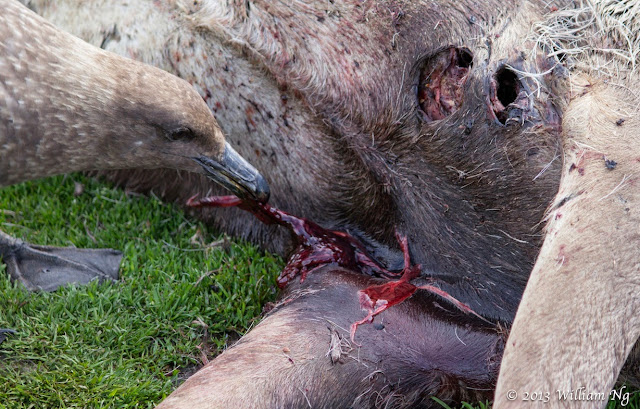
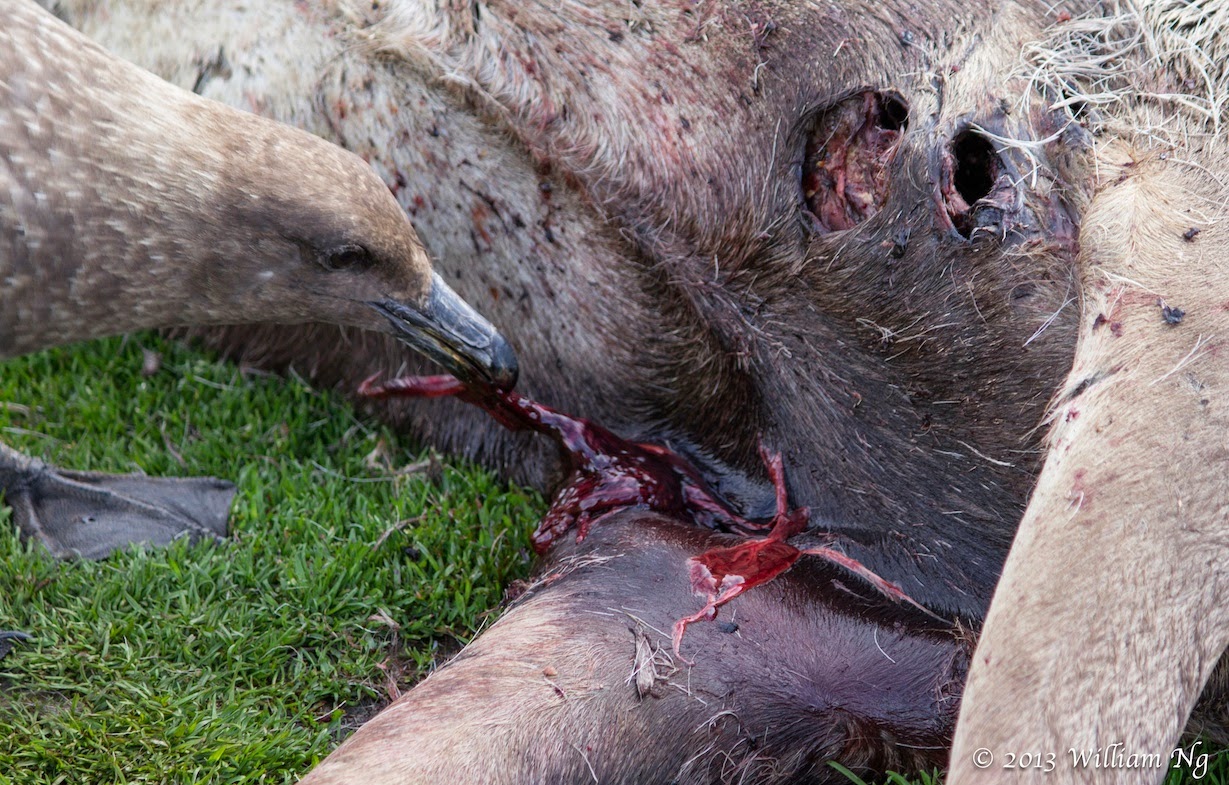
Sometimes the reindeer is just left, to the delight of scavenger skuas.
 
Derelict whaling stations scatter across South Georgia. Most of them are closed to the public due to risk of asbestos. The only one that was open to us was in Gryvitken. These vats were used to boil the whale blubber to extract whale oil, once the giant whales were carved up...


A photo found in the Gryvitken museum depicting the process of skinning and carving a whale using a range of tools once it was taken back to the station.
There were lots of fascinating history in the museum. In order to make the process of hunting whales more efficient, whaling ships harpooned a floater and a tracking device into the whale so they could keep it afloat and track it later while they move on to make another kill, and so on, until the end of the day when they return to tow them all back to base.


A set of whale bones found at Port Lockroy in the Antarctica Peninsula.


Two gentoo chicks seeking warmth from their mother. It was with almost certainty that the smaller one will not survive. Winter is looming and it just isn't big enough to survive the cold, nor is it able to compete with the older sibling for meals from the parents.


Dead penguin = good meal for scavenger skuas


Just to end on a slightly happier note, this is how they make little penguins.


Sunday, 5 May 2013

What to do if you travel to the Falkland Islands

Having spent 30 hours and over £2,000 travelling to the Falklands, I was eager to spend some time exploring this island rather than just passing through it for Antarctica. So I was very much up for going on a day trip when my fellow traveller Anthony suggested it. We had a full day the day before we set sail, so we decided to visit Volunteer Point, which has the biggest colony of King penguins in the Falklands region. 

Volunteer Point is a headland in the north eastern tip of the Falkland archipelago. On the map it looks quite close to Stanley, in fact a direct line between the two is just under 20 miles. However in reality there is a bay between the two places and to actually get there requires off-road driving in a 4x4 and takes about 3 hours. None of us had off-road driving skills, nor would the car rental companies provide the insurance for such a potentially hazardous endeavour, so getting a local guide to take us was the only option.


We went with a lady called Charlene who Anthony found on the Falklands Tourist Board. She was very friendly and talkative, and was willing to answer any questions we had about life on the island, which made the 3 hour drive much shorter and more pleasant.


For a day trip to Volunteer Point, tea and coffee included but BYO lunch, we were quoted £150 for 1, £280 for 2 or 3, and £330 for 4 people (as of February 2013). Cash payment only so make sure you bring enough Pounds to the Falklands as there are no ATMs on the island and the only bank (Standard Chartered) charges a fee to withdraw cash (see packing list here).

We had been told to meet at 7am to beat the cruise ship that was making a landing in the Falklands that day; apparently there would be about 200 people filling 60 or so 4x4's. Really not my idea of how to see penguins. Luckily they landed the day before, so we didn't have to fight for space, and we didn't have to leave til 8am. The extra hour of sleep was bliss, and it still meant we got there by 11am and still had a good 3 hours exploring and photographing penguins.


There were plenty of mine field signs in the East Falklands, especially around Stanley - a stark reminder of the recent Falklands War. I'm still not sure how slowing down would help though if you were driving through a minefield...

After three hours of on and off road driving, stopping for the occasional scenic shots, and lots of bumping up and down (apparently it was good practice for sailing), we arrived and left our lunches and bags in a small huts provided as shelter for visitors. It had a coffee table and a few chairs, with some information posters and maps on the wall. Next to the hut were 3 portable toilets and a tap that didn't work (mental note to self, don't get hands dirty, and don't drink too much tea). Just imagine what it would have been like if those cruise boat tourists descended on this place.

Apart from the usual "don't leave any rubbish" rule, Charlene emphasised two specific ones:

1. Don't touch the penguins (that includes hugging, picking them up, stroking, harassing, booting...)

2. Don't cross the stone circle around the king penguin colony. The circle marks out where they generally breed, lay eggs and raise the chicks. Going inside the circle means getting too close which in turn means potentially scaring them off and leaving their eggs or chicks exposed.

We were first greeted by a small group of king penguins, who looked on with an air of dignity and indifference. In fact, most of them didn't even bother looking, and just carried on walking about minding their own business. We followed them down to the main colony, stopping to photograph their comical movements and behaviour, and a few astray gentoo penguins.


At just under 1m tall, the Kings are the 2nd tallest penguins behind the Emperors, but just as colourful and beautiful. Their back and flippers are charcoal grey, while the front is a beautiful white. Towards the neck the white plumage smoothly gradients into a brilliant golden orange, which extends around the neck like a collar, while the rest of the head is black. Kings are also characterised by a black and orange bill.

The vibrance of their golden necklace illuminated the scene. Some stood tall, raising their heads and scrooching to the rest of the crowd; some just lay down to rest, while some pretended they could fly...


Slight digression; I still cannot believe I fell for this April Fools'... (full credit to Eric and Simon for making me believe, full credit to me for being gullible).

Photographing the Kings was easy; photographing the Kings' behaviour was way more challenging. But the most comical award had to be this:


We spent an hour or so photographing the kings' colony. We really took our time, I guess partly because we were so excited seeing penguins for the first time, and partly because we wanted to get as much practice at shooting with our cameras before the real deal.  

As we started making our way back to the hut for lunch, we came across a smaller and looser group of Gentoos. These were mainly chicks or juveniles, and were far friendlier and more inquisitive. As soon as we slowed our steps, 4 of them came over and crowded around us. Another two just went mad and started running around crazily, screaming and flapping all the time. They got quite friendly mainly with Anthony, pecking/sneezing/spitting, even jumping onto him (including sensitive areas). But we didn't care, the photo opportunity was priceless. When I finally picked a patch of grass where I could not see any penguin poo or snot, I too decided to sit down and one very inquisitive chick came up close and pecked me in the leg. It hurt more than I had expected, and my slight sudden retreat must have startled the chick a little. He kept his distance after that.

Anyway, Charlene said we weren't allowed to touch them, but she didn't say we weren't allowed to let them touch us.


We went down to the beach after lunch, and what a beautiful beach it was. White sand, almost completely unoccupied except for a few Kings waddling around, occasionally jumping into the radiant green turquoise water. The only things missing were palm trees and hammocks. It would have been a paradise if it were not for the penguin poo dotted around, and the extreme windchill which forced me to wear 3 windproof/thermal layers even though it was the tail end of the summer. It was actually so windy that at one point I was transfixed by the constantly changing patterns made by the fine grains of white sand as they were blown ferociously across the beach. It would have been great to take time lapse shots, but hindsight is always bliss - it was only the first day I tried out my brand new Canon 600D properly and I hadn't even heard of the terminology.


Despite the windchill, the penguins seem to love it though, so I guess at least someone was benefiting. 

On the way back to the 4x4 we took a quick glimpse of the Magellanic penguins, even spotting a dead one lying on the ground. I didn't get to spend much time with them, although I really would have liked to. It later turned out this was to be our only opportunity to see this species.

It was a great day trip and I would highly recommend Volunteer Point to anyone visiting the Falklands. The 6 hour return journey of bumping up and down in a 4x4 was definitely worth it. Although I only spent a few hours with them, I already had a lot of admiration for these wonderful creatures and their ability to survive under these sub-Antarctic conditions. 

What a fantastic prelude to the Deep South.

For more information about Volunteer Point and the various penguin species and colonies in the Falklands, visit the Falklands Conservation website, where you can also adopt a penguin.


Sunday, 31 March 2013

Video Diary: To Jump Or Not To Jump?

When people ask me about Antarctica, questions on penguins and ice come up a lot, so it is only apt to write a blog post about both of them together. Indeed, this had to be one of my top highlights. It happened towards the end of the expedition, with only a couple of days before we were home bound, so seeing this really made my day and flushed out all the start-of-the-end-of-a-holiday blues.

You often find groups of penguins hanging out on bergs, especially big ones. My guess is they needed a solid platform in the open sea to rest overnight; or to avoid leopard seals that wanted a penguin meal, the little fellas needed somewhere to camp out. Or maybe, they were just chilling out for the weekend, have a nice sun bathe. I prefer the latter, it's cuter. Whatever the reason though, there they were, two groups of gentoos on a horseshoe shaped berg (two seemingly distinct icebergs above water but actually connected underneath).

I don't think they were the biggest fan of boats or humans though.

The group that was camping on the larger but thinner berg was already on the way down to the bottom of the ridge ready to go fishing again, but they spotted us as we approached and made a very quick collective decision - head back up the ridge as fast as they could. In fact it was probably one penguin's decision and everyone else just followed. Penguins are very much like sheep in this respect.

And so they ran and scrambled and jumped and flapped and crawled. Part of me felt a bit bad - our presence was clearly disturbing their peace - but it was also very comical. Oh well, they have their revenge on me every time I get their shit on my boots and clothes and have to scrub it off! The closest we got was when we sailed in between the horseshoe, by which point the gentoos decided it was best to stay put to see what would happen next.

The Fleece circled the berg a couple of times and every time we sailed to the other side of the berg, our little friends would run in the opposite direction, up and down the ice ridge. They did take the opportunity to jump into the water eventually, when our attention turned to the group on the smaller but flatter berg...

There was only about 6 or 7 fellas left on this berg by the time we closed in on them (for no other purpose but to shoot, photos that is). As they got to the edge which was about 2m high, you could see the leader's brain ticking, quickly assessing the situation, the risks and all the possible outcomes of the decision he's about to make or not make.

He looked back at the group, perhaps for a democratic vote, or an approval, but more likely to see if they had any alternative suggestions. Then, as if they conferred telepathically (there definitely wasn't any open debate), the leader walked up to the edge and jumped, followed by the second, the third, the fourth...

Finally, the fella at the back of the queue walked up to the edge, looked down into the water and stopped. It's too high, he said. Now it was me who was having a telepathic conversation with him. He turned back and walked away from the edge. For a long time he was walking around all by himself, and his friends long gone.


Eric Carmen's All By Myself came to mind...