Sunday, 11 September 2016

Roll On Hong Kong


Greetings from Hong Kong!

Well well well, it has been over two months since I moved (back) to Hong Kong, but it definitely feels like much longer than that. And what a fascinating time it has been.

During that time, I have:
  • Successfully completed a project assignment for Earthwatch, acting as a facilitator for their Alcoa Sustainability Fellowship program. It was a great learning experience for me and I had loads of fun!
  • Started working for a local consultancy as a Sustainability Advisor, which has been interesting. Lots to learn and plenty more to look forward!
  • With the help from a friend, mapped out my life goals and a one-year plan to go with those.
  • Explored parts of Hong Kong I had never seen before -- Mai Po Nature Reserve (米埔), Tiu Keng Leng (調景嶺), Long Ke Wan (浪茄灣), Cheung Po Tsai cave (張保仔洞), Lion Rock Hill (獅子山), and the Heritage Lodge (饒宗頤文化館).
  • Revisited some excellent locations -- Cheung Chau (長洲), Sai Kung town (西貢), TST pier (尖沙嘴), Lan Kwai Fong (蘭桂坊) and Ladies Market (女人街).
  • Met some interesting people at a number of networking events.
  • Trialled a Kempo class -- sadly no one else came, but I did get a good workout and revision of the techniques.
  • Done some comprehensive research into the local mobile and broadband providers. Message me if you’re new to Hong Kong and want any advice ;-)
  • Had a few visitors already, and looking forward to many more in the coming months :)

A bit about my typical day, in case anyone thinks I've been bumming around all the time ;-)

So as a contractor I “work from home” on most days (but that also means I have to be disciplined). What that really means is that my commute is usually a 3-minute walk (more time for sleeping!) -- either to the local library (my primary office), or the local McDonald’s or Starbucks (my secondary office). The local library is actually a great place to work -- it is free, quiet, has good WiFi, and has decent opening times (9am-10pm most days; 12-10pm on Thursdays, 9-5pm on Sundays). But there are some drawbacks: the air conditioning is often too cold; being a library I can obviously only take calls outside in the corridor; the toilets are pretty dirty and smelly. Otherwise, McDonald’s and Starbucks are excellent alternatives if I need a change of scenery, or when the library is not open. Only thing about McDonald’s is it doesn’t have power sockets, so I can only stay there for as long as my laptop’s battery life. Obviously both locations come with a price tag -- the lowest expenditures are $4 for an ice-cream cone in McDonald's (but very unhealthy), or $25 for an iced coffee in Starbucks (but I'm trying to cut down on caffeine). But hey, beggars can't be choosers. It’s usually harder to keep your seat in McDonald’s if you want to leave your seat to use their (very dirty) toilet. It can be pretty noisy too, as it is often filled with rampaging kids. Some might even sit next to you and read out loud what you’re typing. Very annoying indeed. Starbucks is generally much better by comparison, though I've had to write to their head office to suggest they turn down their air con as I'm usually freezing cold despite wearing an extra layer of long-sleeves. 


I have also managed to maintain my meat-free diet. In all honesty it has been much harder to do than in the UK, especially when I eat out. Everything seems to have pork these days, even “prawn dumplings”. But it is doable. Guess I just have to eat more fish balls and sushi!

I must admit that the premise for my move to Hong Kong has changed somewhat - things haven’t quite turned out quite how I wanted / expected them to. But, c'est la vie, here I am nonetheless, and I should definitely not let it be a reason for not making the most of my time here or make it as successful as possible. Roll on Hong Kong.


Tuesday, 26 January 2016

The madness of Venezuela

Most of the travellers I've spoken to felt it was too dangerous to go to Venezuela, yet they were very curious and found it a fascinating place. Safety was my biggest concern too; I'd been advised against travelling to this country by several friends; a film crew from a Chinese travel program went to Venezuela and had to be picked up by armed guards on arrival; the FCO advised against all travel to the Venezuelan-Colombian border (though that wasn't where I was going).

Bearing in mind that my entire stay was organised through a hiking agency - from pick up on arrival to drop off on departure at Caracas airport - my experience was probably quite sheltered and skewed. Nevertheless I'll share my experience and some of the things I learnt during my two weeks there.

1. Currency

If you do go to Venezuela, MAKE SURE YOU TAKE US DOLLARS with you. At the time of my visit, November 2015, the official exchange rate (e.g. xe.com, rates used by credit/debit card companies) was around 6 Bolivares to the dollar. The exchange rate at local casa de cambios (e.g. Italiocambio) was around 200 to 1! But if you changed your dollars on the black market (e.g. anyone in the street or shops willing to do so, but be careful), the rate ranged from 600 to 800 Bolivares to the dollar!!

Which is why you should never use your credit or debit cards under any circumstances!

The largest note is Bv100 (a typical lunch in a local restaurant sets you back Bv1200). It is not uncommon for people to carry thick wads of cash. Wallets are pretty useless!

The highly ridiculous differences in the exchange rate was largely due to the huge desire for US dollars, presumably because of the highly volatile commodities, and the seemingly worthless local currency.

Locals cannot change their Bvs for USD. Importing goods (e.g. medicine) is therefore extremely expensive for locals, but sometimes they have no choice as pharmacies do not have 60% of what they should have (due to insufficient funds to import).

2. Oil and petrol

1 Bolivares buys you 10L of gasoline (that's 1/600 US dollar if you changed the money on the black market)!!! The country is rich in oil, and has been relying in it since the start of the 20th century, but currently it has no capacity to refine. A big refinery blew up a few years ago, and has not been repaired it replaced. It now trades oil with America for part cash part gasoline.

When I was in Santa Elena there was a very long queue for the petrol station. It was mainly because Santa Elena was so close to the Brazilian border that people were crossing from Brazil to fill up tanks or locals filling up to resell the petrol over the border.

3. Industries

Many Venezuelan industries have collapsed. Many mining and metal extractive industries now owned by the Chinese. Its reliance on oil has meant that all other sectors have been neglected, hence the import of almost everything (e.g. toilet paper).

4. Livelihoods

Some Venezuelans only earn Bv8000 ($15) a month, a whole chicken costs Bv1200-1800. Typical local breakfast costs around Bv100-400. Food basket for an average family costs Bv80,000 per month but supervisor at post office earns only Bv15,000.

Several years ago Chavez lowered the price of beef from 20/kg to 3.8/kg enforced with guards for 3 years so no more meat sold on official market. Corruption prevails, according to a local.

Unemployment is high. Education system was screwed up in the 80s/90s, even everyone could pass high school and university. School teachers were lazy and students didn't have to do much to qualify, who have now become the "lost generation". Most of the population is 35 or under, but lots of people do not understand the failures of the state. Some blame the Chinese for 'milking them'. Lots of people have left the country for better opportunities.

Due to low stocks, when buying things in some shops, e.g. pharmacy, proof of us required - only certain digits can buy on certain days of the week. A way to ration and stop people from buying stock up to sell on black market.

Sunday, 24 January 2016

Venezuela - Travel Tips and Advice for the Roraima trek and Angel Falls

I did both Roraima and Angel Falls with Hike Venezuela, costing a total of $660. I've included the itinerary at the bottom of this post.

When taking overnight buses, make sure you bring a fleece and sleeping bag. The air conditioning on long distance buses is very powerful and it gets really cold. Keep all your valuables with you.

Also bring enough food and water, the bus does not stop for dinner or snacks. There is a toilet on board but it's quite disgusting. The lights go out pretty much as soon as you set off, and the reading lights don't work, so there's not a lot to do for 12 hours.


Not far into the trail you will be attacked by puri-puri, small flies that bite and leave a red round mark / dot. They are much itchier than mosquitoes and they are not afraid of DEET! I had another bug repellent (Care Plus from Decathlon, active ingredient Citriodiaol 19.2%) which did work. Having a head net also helped (but I got lots of funny looks from other people).


Pack warm and waterproof gear (jacket, gloves, hat, poncho). The weather changes more regularly and abruptly the closer you get to Roraima. Temperatures drop as well as you go higher up, especially when the sun is gone. The persistent mist/fog at the top also makes it feel colder. You'll also have to walk under a waterfall on summit day, so bring a poncho (I had an umbrella but that meant I couldn't use one hand, which could have been disastrous on a slippery climb). Have a rain cover for your rucksacks.

Bring a couple of pairs of spare socks. You'll need to cross two rivers and the rocks are very slippery, but having socks on helps.

Your agent will tell you this before you set off - put an extra plastic bag liner inside your rucksack, in case the rucksack falls into the water from the river crossing. If you have dry bags that's even better.

There was no electricity at all for 6 days so bring extra batteries for your phones and cameras. It gets pitch dark by 6pm (in November) so we just went to bed after dinner. The upside was I woke up naturally quite early everyday, around 5am, which was perfect for seeing sunrises.

You can wash (yourself and your clothes) almost everyday, in River Tök, at the base camp and also at the top if using natural organic biodegradable products. Be warned, the water is cold though.

Always pee away from water sources. For no.2, your porters will dig a hole in the ground at the camp sites below the mountain. At the top you should be using a plastic bag provided by the porters, who will also give you white powder to line the bag (I couldn't work out what the powder did but I didn't spend too long investigating either). Tie the bags up and the porters are supposed to take them down the tepui to be disposed of. Never leave your waste in at the top or in the open, and insist on your porters follow the rules (sadly I saw lots of human waste left behind).

There are lots of quartz crystals at the top. They are beautiful but don't take any away. Sadly lots of people do this. Not only is it illegal it is also immoral.


When trekking especially coming down try not to use trees for support too much - quite a few young ones are already loose and on the verge of being pulled out by tourists holding onto them for balance or support. It's bad for the trees' health but also dangerous for the trekker.

If you see any litter on your way up, mark them outso you can pick them up on your way down.


Itinerary

Day 1

Arrive in Caracas and overnight hotel - US$35pp

Day 2
Internal flight to Puerto Ordaz (8am) - US$25

Transfer to Cuidad Bolivar (9.30am, 60 minutes) - US$15
Night bus to Santa Elena (5pm, 12-16 hours) - US$10


Day 3
Arrive in Santa Elena (7-10am), overnight in posada - US$10
 

Day 4-9 
Roraima Trek 6D/5N (5 breakfasts, 6 lunches, 5 dinners) - US$245
 

Day 9
Afternoon back from trek (3-4pm)
Nightbus to Puerto Ordaz (5-6pm, 12-16hours) - US$10

Day 10
Arrive in Puerto Ordaz (7-8am), overnight in Posada - US$10

Day 11-13 
Angel Falls 3D/2N - US$245


Day 13

Flight back to Puerto Ordaz (9-10am)
Flight to Caracas (5pm, 1 hour) - US$20
Overnight hotel - US$35

Day 14


Transfer to international airport


Friday, 1 January 2016

Gratitude

I am grateful to my parents, for everything they have done for me throughout my life; for all the cold long dark days they had to endure at the takeaway; for dealing head on fearlessly, or sometimes fearfully, with the uncertainties that moving to a new country brought; for painstakingly learning pretty much all my primary school curriculum with me while running the shop (except that time when my Dragon Ball Z comic book got ripped up). Forever indebted, no words can describe it.

I am grateful to my sisters and family, for all the support they've given me, especially behind the scenes; for the fun we had when we were much younger (and for using me unsparingly to run errands for them); for their trust; for their wise advice when most needed; for the amazing meals you've cooked for me; for being there no matter what. Thank you.

I am grateful to all my friends - past and present; the critical ones (you know who you are) for keeping me on my toes; the wise and reflective ones for asking me the important questions and making me think;
the fun ones for bringing more colour into my life; the similar ones for making me see my flaws; the ones with completely different personalities for making me less monotonous and a bit more interesting. Even those who have walked in and out of my life have contributed to making me who I am today. Thank you for being there when I most needed you, thank you for being there even when I didn't need you, thank you for your inspirations, and thank you for not judging.

I am grateful to my Kempo teachers and training partners - you are all both my teachers and my friends. You have kept me from getting fat (hard to believe eh?), taught me a lot about the martial way and Zen philosophy, and played a big part in my twenties. Without Kempo and without you, I would probably be a completely different person today.

I am grateful to all the people I have worked with - colleagues, clients and friends; for all the opportunities you've given me to learn and develop; for all the fun we had together that made work more bearable; for all the free teas and coffees and biscuits and beers and champagnes; for the trust you placed in me even if sometimes I didn't know what I was doing!

I am grateful to the people I have met on my travels, fellow travellers and locals alike; for enriching all these unique experiences; for giving me directions when I'm lost; for going the extra mile to help me fix my bag zip or looking after my phone when I left it behind and so much more; for your recommendations and travel tips; for putting up with my snoring.

I am grateful for being alive! Can you imagine being otherwise? It'd be pretty boring I think.

I am grateful for the air, every breath so refreshing and revitalising.

I am grateful for my eyes, for allowing me to see so many beautiful things. And I am grateful for all the beauties in this world - the sunsets, the sunrises, the blue skies, the turquoise and deep blue waters, the snowcapped mountains, the lush green forests, the magnificent rainbows, the brilliant starry skies, the light and the darkness.

I am grateful to my food - you taste great (most of the time) and you keep me going. And I am grateful for my taste buds and my stomach, for all the wonderful sensations I experience everyday!

I am grateful for my body, for allowing me to travel and do all the things that I want.

I am grateful for my mind, for letting me think and wonder and imagine and ponder and appreciate.

I am grateful for the world - mother nature - the mountains, the seas, the lakes, the trees, the wildlife, the cities, the people - for giving me opportunities time and time again to let me experience and learn about you.


Thank you all.

Wednesday, 30 December 2015

Venezuela - Angel Falls

Typical Angel Falls excursions last for 3 days and 2 nights. The Falls is on the western side of the Canaima National Park, which can only be accessed by domestic flights (about 45 minutes from either Cuidad Bolivar or Puerto Ordaz). The Falls itself then requires a motor boat ride upstream for 4 hours to the camp, followed by a 60-90 minute trek through a dense forest of thick and intertangled roots. That was basically how I spent my first day of the excursion, bar the trek which we saved for the morning of day 2, as we arrived at the camp with only about an hour of daylight left.

While it might sound pretty tough going (and believe me, sitting on a motorised canoe on a hard seat with no backrest for 4 hours is pretty tough on your butt), most of the journey was very enjoyable. The flight to Canaima was made in a light propeller aircraft at relatively low altitude so we had excellent bird's eye views of the national park down below.


When I got to Canaima airstrip I couldn't find my contact who was supposed to pick me up, but luckily I'd made a few friends back at the airport who were also staying at Kavac Lodge, so I went with them. When we got to Kavac Lodge I was out with another group who had arrived earlier from Cuidad Bolivar - José from Roraima was amongst them, and it was good to see him again!

Within half an hour we were off again. Because of my early flight on day 3, our guide decided to go straight up to the Angel Falls camp for the first night, then come back to the lodge for the second night. After a short ride up a dirt track, we got to our boat and loaded all our luggage and food on.


Rio Carrao was much wider than I expected - the two rivers we crossed on the Roraima trek were babies by comparison. This one looked calmer but much deeper too - I wouldn't fancy my chances trying to cross it without a boat.


But it wasn't calm all the way up. Within 10 minutes of riding upstream we had to disembark and walk for about 20 minutes because the boat was hitting rapids and it was unsafe for us to stay in it. The driver picked us up further upstream.

But there were actually many more rapids upstream, and it was really fun navigating through them! As they were caused by a change in the depth of the the river (e.g. big boulders on river bed), the canoe driver had to work out which way to go so the boat didn't hit big rocks or get stuck in the shallows. We, the passengers, were left to our fate over how wet we would get as the boat charged through the water! There was a section that was so narrow because of giant boulders in the middle of the river that it was called the Devil's Gate.


We stopped by a small waterfall for lunch (very warm and soggy cheese and ham sandwiches) where we had some time to go for a swim too. I didn't know about the stop so my swimming shorts and towel were inside the big backpack, which I couldn't be bothered to get out. To be fair though I was already so wet from the splashes from the rapids that I might as well have jumped in anyway. But it was OK - I would save the swimming for the big one the next day. 

The scenery along the way was incredible too. The river was flanked by dense mangroves, and every now and again a towering tepui appears in the background. They were all of different shapes and sizes - a memorable one looked like a skateboard ramp. It was only later that I realised they were all one tepui, the Auyán-tepui; we were just seeing different parts of it at different sections of the river. Some parts of the river was so wide and calm that we had almost perfect reflections of the blue sky, grey tepuis and green forests down below.


And so with such beautiful Jurassic-park scenery and excitement at the dozens of rapids, the 4 hour ride went like a breeze. The majestic and elusive Angel Falls fell into sight as we approached our hammock camp at around 4pm. But she wasn't going to make it easy - we were only allowed a cheeky peek of her upper half; to see her full glory would require more hard work the next day ;-)

We spent what was left of the daylight walking upstream to another camp that had a better view of the Falls. I was hoping for some good sunset shots but the sun had already disappeared the Falls and the tepui so we were at the wrong angle. It was nice to be out in the wilderness once again nonetheless, this time without mosquitoes, allegedly because the red water is too acidic for them to lay their eggs.

On our way back to our camp my fellow German traveller/photographer stopped to speak to a group of German tourists, and I struck gold. When I was on Roraima all but one of my camera batteries had run out and I had left the charger back in luggage storage in Caracas. I had no idea if the remaining battery would last until the end of the Angel Falls trip, and it would be tally annoying if it didn't! But I was really lucky that one of the German ladies had a similar camera (and therefore battery and had the charger on her.) Woohoo!

One warning about the hammock camp: there are cockroaches. Shortly after getting ready to sleep, I went to get something out of my backpack, and when I turned on my headlight this filthy piece of shit had already crawled inside my backpack liner. He went deeper in every time I try to get it out. Eventually I had to cut up the plastic liner and transfer everything to another bag. He was nowhere to be seen and to this date I still have no idea where the hell he went. Little fucker. (And yes I have a phobia of cockroaches)


I got up before dawn the next morning to take sunrise shots of the Falls. The weather was perfect - as the sun coloured the top of the Falls golden orange, a thin slither of mist also floated up into the frame. I felt very lucky :)

After breakfast we set off to climb up to the viewpoint and to the bottom of the Falls. The trek was a walk in the park compared to Roraima, but the forest floor was made up entirely of tangled tree roots, on which grew an abundance of moss, which made it very easy to slip or trip over.

Within an hour we were at the viewpoint and were just about able to see the Angel in her full glory. Water flowed graciously from the top, each droplet performing their once-in-a-lifetime Olympic dive. As they fell they opened up and spread out, synchronising with each other. Towards the bottom they gathered again and congregated all their energy for a final push, and roared with triumph as they sailed powerfully to the pool at the bottom. But it wasn't over yet, their journey would continue for miles, joining their rivals from other waterfalls in the red river. But it was clear who the winners were.


On a less poetic, but very relevant side note (given the recent climate change agreements signed in Paris), our guide told us that as it was officially the wet season, there should be much more rainfall than what we had, and the waterfall is usually covered by clouds. But because of global warming and El Niño, the weather has been much drier and more erratic throughout the year. This wasn't the only example that I've heard local people talk about climate change during my trip either.

The viewing platform was actually on a slight slope, at the end of which was a vertical drop. We attempted (very carefully) a few jumping shots anyway.

Then it was time to descend to the bottom of the falls, which allowed us to admire her magnificence up close, as well as swimming in the pool at the bottom. The water was cold, and took a few minutes to get used to but thoroughly enjoyable once you were in, especially if the sun is out. The rocks at the bottom of the pool were uneven and slippery though, making it very difficult to walk around, particularly as the water was too 'red' and there was too much froth to see through. At one point I slipped and hit my left foot against a rock - it was so painful I almost thought I'd broken my toe (luckily I didn't coz they would be quite shit). It was bruised for a few days though.

Most of the guys in the group who were more comfortable in water were able to swim up to where the water impacted the pool. They were even able to lean back without touching the wall because the force of the water was so strong. I only managed to get within 3m before I got pushed away. It is hard to describe with words or even photos - you really have to experience it for yourself!


We spent about an hour swimming and taking photos before heading back to camp for a quick break in the hammocks and lunch. The return boat ride, downstream this time, was a bit quicker and still fun navigating the rapids.

We got back to the lodge area by about 3.30 but that wasn't the end of the tour yet. We still had to see three other waterfalls that emptied into the red river.
 

The first one wasn't that full so we could actually walk right up to it at the top. We were treated with a great panoramic view of the bay and palm trees on the opposite side too. 

Then we saw Sapo Falls, which was extremely powerful and you could either admire from the beach on the opposite side (where we started) or on a boat (where another group of tourists were, which provided a great opportunity for a sunset silhouette shot). Better still, you can go right up to it and walk BEHIND it, which was exactly what we did. We got very wet in the process - even my dry bag could not protect my camera and phone completely from the force of the water.


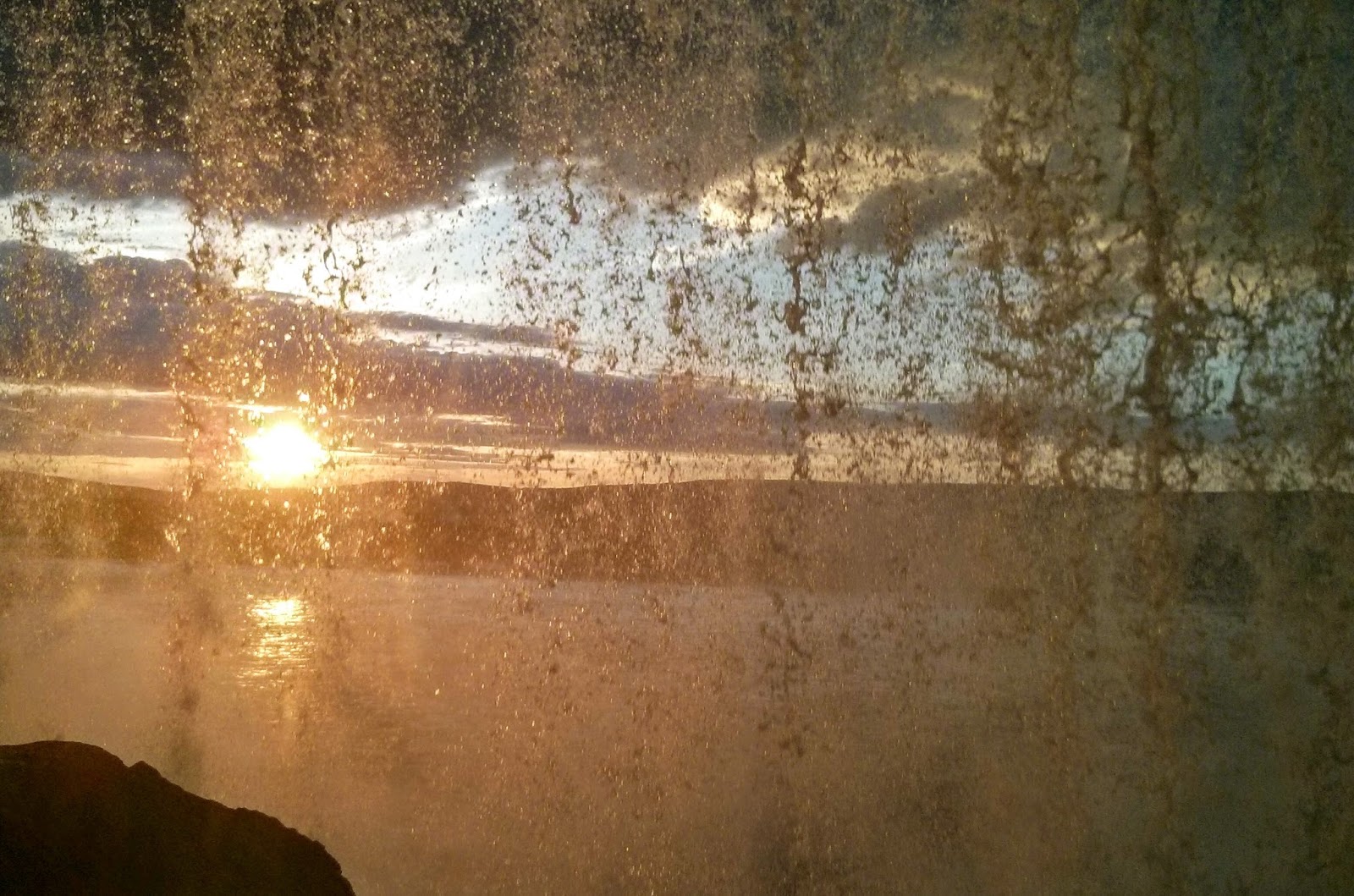
But it was worth it. Not only could we walk from one end of the waterfall to the other, see the enormous gush up close (and realise how easy it was to just step onto the boulder, take a couple of steps, and disappear into the veil of whiteness forever) - no, not only these, we were also treated to the sunset behind a curtain of water, every droplet glistening in the orange yolk, reflecting and refracting the radiance that made the whole world glow in golden superiority. It was a perfect end to the tour.

(The actual end of the tour was much more underwhelming - by the time we got back to our lodge it had started raining. The clouds lingered well into the following day, much to the others' disappointment as they had planned to take the $80 flight over the Angel Falls to see it from another angle. Indeed, the third day of my 3D/2N excursion only consisted of breakfast and a transfer to the airstrip to fly back to Puerto Ordaz. I ended up writing a complaint email to my agent about the slightly misleading itinerary.)

Thursday, 24 December 2015

Venezuela - Roraima Trek - Days 5 and 6


Day 5

This was the toughest day of all. I've always enjoyed the ascent much more than the descent; I find the latter much harder work to keep stable, and more fatal if I took one wrong step. The only two blisters that I got from the entire trek also came from the descent. Ah well, tough shit.

The route down was identical but in reverse as the route up, except it was quicker so we did the equivalent of Days 1 and 2 all on Day 5, camping at Tök. The water at Rio Kukenán wasn't as high as before, so we were all able to walk across the boulders, with Marisol's help. No need to swim and no rope (and splinters) this time!

Marisol told us at dinner that one of the people who had been on the way up earlier in the day had slipped when they passed under the waterfalls, and was likely to need helicopter rescue the next morning due to a potentially serious head injury. We were all thankful that we only came away with insect bites and blisters.

According to Marisol three tourists have died on Roraima in the past - two of heart attacks, and one under unknown circumstances. Apparently the guy had commented "this isn't a bad place to die". He then insisted on staying an extra day at the top, while the rest of the group went down (after signing a disclaimer for his own safety etc). On the way down the guide had a bad feeling, so he sent a porter and the man's nephew back up, only to find him dead for no apparent reason. I was glad that Marisol left these chilling stories til after we left.


The last day

It was sad to leave Roraima. I looked back several times as we approached the gateway to the ramp, part of me wished we had more time to explore at the top, but I was also happy that we made the most of the time we had. I felt extremely grateful to have made it. And I realised that every step I took was not only of my own effort, but also the effort and help of the stones and rocks and branches and trees that supported me, stopped me from tripping or slipping, and helped me reach the top. I used to think about 'conquering' mountains, but now I realise how small I was. Even a small stone along the path has been there for millennia before me, and will be there for millennia after me. It has seen everything, and I was only a fraction of a nano-second by comparison.

Roraima was an incredibly humbling experience. She was hard work but beautiful, tiring but humbling. She was incredible in every detail. She was magnificent.


On the drive back to Santa Elena we stopped briefly at the Jasper Creek - the red colour of the riverbed is due to the colour of the mineral rock. It was very pretty :)


One last bit of drama, though it wasn't us this time. Another of the 4x4's had broken down so our driver stopped to help. We ended up towing them all the way back to Santa Elena for an hour on a loose rope. It was a good thing that their brakes were still working...


Tuesday, 22 December 2015

Venezuela - Roraima Trek - Days 3 and 4

I got up at 5.15 to watch sunrise at the base camp. As the sun rose above the horizon, it lit up the walls of Roraima and Kukenán from crimson red to a brilliant golden orange. It was incredible scenery, particularly as clouds moved through the valley between the two tepuis. Wished you were here - you would have loved it too :)


The trek today was hard. As soon as we left the camp we were already hitting almost vertical climbs and had to scramble our way up. The route to the top was simple - get to the wall of the cliff then follow a steep "ramp" along the side of the wall all the way up. For the first two hours we were forever trying to get closer to the wall; we were always so close yet so far away. Brice had already disappeared ahead after 5 minutes; I was mainly walking with José, Maria and Norman, with Flavio, Daniel and Marisol behind.

The steepness gave us plenty of opportunities to take short breaks and look at the flora and fauna, with explanations from Norman, our resident biologist who came on this trip to document plant species.

Then after two hours of hard climbing we finally got to the wall. It stood as tall as ever and we felt no closer to the top than we had been two hours before. We continued nonetheless. Along the ramp there were two 'viewing platforms' where we had a panoramic view of the valleys below us - it was incredible. The base camp looked so small now.


Marisol instructed us to wait for her at the second viewing platform, which we did (I didn't want to defy her again after the river crossing). From there we could trace the route all the way to the top now, which involved walking under two waterfalls. Although the reality was having heavy rainfall for about 3 minutes, it was quite cool and fun. Whilst everyone had their ponchos, I had to use my umbrella and was told later that I was being English :)


From the start of the ramp to the top took another 3 hours - mostly consisting of almost vertical climbing. After the waterfalls we split up again. I was slightly faster so I followed a porter up, while Marisol and Daniel stayed back with Flavio, who had a knee injury from a cycling competition before the trek.

The sun was replaced by mist by the time I got to the top. It looked like a completely different world. The landscape was formed by black volcanic rocks of different shapes and sizes, with patches of plants growing on softer swampier ground. There was no trail anymore so I had to follow the porter closely to avoid getting lost.

We camped at Hotel Principal under the cover of a giant rock formation, which was incredibly fortunate as it rained quite heavily after lunch in the afternoon (lots of groups had to camp out in the open). It was already 4pm when the rain finally subsided, so we decided to go up to the summit which was just opposite our campsite. Despite the persistent clouds we were treated to a great view of the valleys below. 


As we started to make our way down, I suddenly felt really fortunate and grateful to be where I was. And it was only possible because of my parents and my family. But I've never thanked them. I've never thanked them for bringing me up, for sending me to school and uni, for the hard long cold hours they had to endure at the Chinese takeaway, for giving me the opportunities to go on my travels and everything else that they've done. I've never thanked my sisters either for their support of my endeavours.

I felt guilty and emotional. I promised that I would thank them when I got back down the mountain. I missed them.


Day 4

At 4am I got up to use the toilet, and saw a beautiful full moon when I came out of the tent, so I decided to stay out to take photos. By 5am the sky was changing from dark blue to light blue with a tinge of red. Then I saw the most incredible sunrise with reflections from the tepui ponds.

Marisol took us for a wall to the 
Kukenán Window before breakfast - cliff and vertical drop with other tepui across and clouds below. The view was out of this world. Unbelievable. Gobsmacking. Magnificent. No words nor even photos could do it justice. You HAVE TO see it for yourself.

After breakfast we went out again, but the weather changed quickly from glorious sunshine to mist/cloud rising up from the cliffs to heavy fog to heavy rainfall. All in the space of 5 minutes. I quite liked the mist and rain - the eerie and mysterious atmosphere added to the deserted alien landscape.


Through the rain and mist Marisol took us to see quartz crystals (apparently lots of these have been taken by tourists in the past), some interesting rock formations (at one point I was sure I was in a Star Wars film set), and plants indigenous to Roraima along the way. We ended at a (relatively small) waterfall not too far from the Kukenán Window, where a few of us took a shower under the freezing cold water but man how exhilarating and refreshing! The water fell hard and cold on my head but it felt so good - if only there was also a hot pool or sauna to jump into! Flavio had a waterproof case for his iPhone and managed to take a photo of the four of us :)


On the walk back we passed another cliff face but it was not quite as spectacular as our earlier visit because of the mist. Before heading back for lunch we had a stop at the 'jacuzzis' - pools of cold water where visitors use to bathe in (or bomb-dive into). I didn't want to get wet again but the others had a great time.


By the time we finished lunch it was past 3pm and the weather had turned for the worse. The incessant rain kept us in the camp for the rest of the day. It was quite nice to have some time to rest and bond with others. As darkness fell the rain and dampness gave the camp an eerie atmosphere, complemented by my albatross soup mystery (which spooked myself out more than it did the others) and Flavio's paraffin lighters that served as our 'camp fires'. The rain was still going when we went to bed at 9.